
AI-Powered Patient Guidance for the Modern Health System
Patients are moving from buttons, menus, and forms toward conversational and voice-driven interactions. Medrics AI helps healthcare organizations meet them there — with a smart assistant service that can guide, answer, and help complete actions across the patient journey.
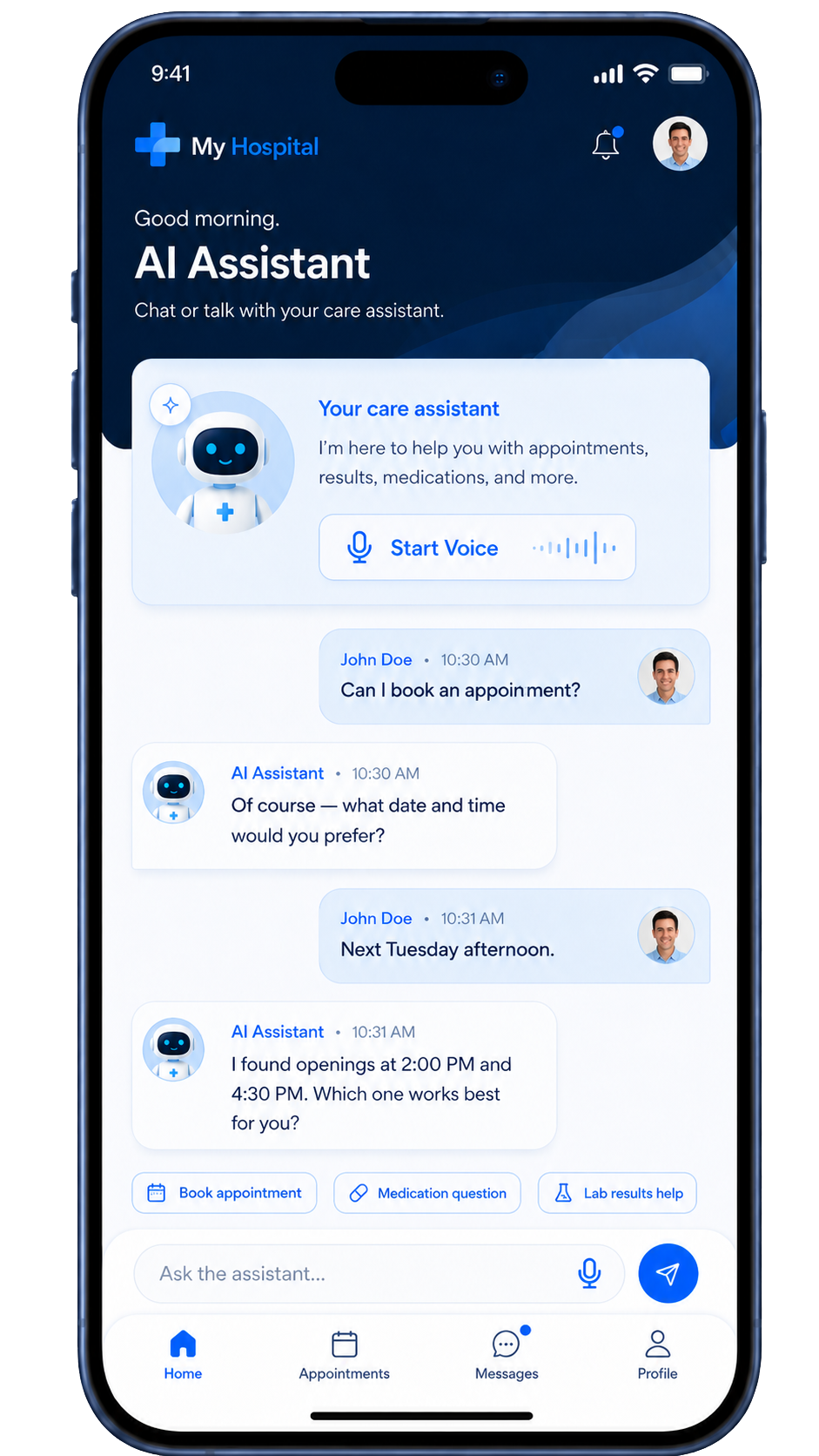
From buttons and forms to conversation and voice
Patients increasingly expect digital interactions to feel natural, immediate, and guided. Instead of hunting through menus, filling long forms, or navigating disconnected pages, they want to ask for what they need in plain language and get help instantly.
Ask instead of search
Patients describe what they need in plain language instead of digging through menus, categories, and links.
Chat instead of fill out
A guided conversation collects the right details at the right time — without overwhelming patients with long forms.
Voice when hands-free matters
Voice-driven access supports patients on the move, at home, or in moments where typing is not practical.
A smart patient assistant that can be deployed as a service
Medrics AI should be positioned not just as a feature inside one app, but as a patient-interaction service that healthcare organizations can embed into their digital environment.
Use it inside the Medrics experience
Deploy Medrics AI as the conversational layer of the full Medrics Digital Front Door — connected to appointments, navigation, and workflows out of the box.
Embed it into an existing digital experience
Add Medrics AI to a hospital's existing app, portal, or website as a smart assistant layer, without rebuilding the entire patient interface.
Offer it as a focused conversational access service
Launch Medrics AI as a standalone access and guidance service for specific journeys, populations, or channels.
One assistant, multiple patient touchpoints
Medrics AI can be positioned as a consistent patient-facing assistant across multiple channels, helping organizations add a new access layer without redesigning every workflow around a new interface.
Mobile app
Can be embedded inside the Medrics app or a hospital's existing mobile app as a conversational guidance layer.
Website and portal
Can be deployed inside patient portals, hospital websites, and web experiences as a smart assistant.
Messaging and conversational channels
Can be extended into messaging-based access points depending on deployment scope and regional channel preferences.
Voice experiences
Can be deployed as a voice-driven interaction layer for hands-free access and call-based guidance scenarios.
Guidance is useful. Connected action is better.
The real value of a healthcare AI assistant is not only answering questions. It is connecting to the systems that already hold appointments, care information, navigation context, and operational data.
EMR-connected access
Can be connected to EMR systems so patients can reach the information and actions that actually live in their record.
Backend-connected workflows
Can be wired into appointment, queue, payment, and operational systems to move requests forward, not just describe them.
Identity-aware guidance
When a patient is authenticated, the assistant can deliver shorter, more specific, and more relevant answers.
Action, not just answers
The assistant can help patients complete a step — book, retrieve, navigate, or hand off — instead of stopping at a link.
Example use cases patients can complete conversationally
A look at how a connected, multi-channel AI assistant can move beyond chat-style answers into real, journey-level outcomes.
Find and book the right cardiology appointment
A patient can ask for a cardiology appointment in plain language. The assistant can guide them toward the right specialty or doctor, check relevant availability, and help move the request toward booking. If the patient is not logged in, the assistant can collect the necessary details for follow-up or confirmation. If the patient is already known, the interaction can be shorter and more direct.
Retrieve the latest lab result
Instead of navigating through menus, a patient can ask for their latest lab result and be guided to the correct report or secure download path.
Get insurance or coverage guidance
The assistant can help answer policy, coverage, and next-step questions or guide the patient toward the right workflow or support channel.
Find the nearest urgent care and get directions
A patient can ask where the nearest urgent care option is and receive guided location information plus a navigation link.
Search, ask, act, and continue in one conversation
One assistant can help patients search, ask, act, and continue — instead of moving across disconnected tools.
Why hospitals should care about conversational access
Lower friction for patients
Replace menus, forms, and call-center wait times with a guided, natural conversation.
An additional access channel
Add a new entry point to services without restructuring existing digital products.
More guided self-service
Help patients resolve common requests on their own — with the assistant doing the navigation work.
Better reach across channels
Meet patients where they already are: app, portal, messaging, and voice.
No need for the full platform every time
Deploy Medrics AI as a focused assistant service even when the full Medrics platform is not in scope.
Designed for guidance, not clinical decision-making
Medrics AI helps patients find services, understand next steps, access resources, and navigate healthcare journeys. It should be positioned as a guidance, communication, and workflow-support layer — not as a diagnostic or treatment decision tool.
Scope-bounded
Focused on access, navigation, resources, and journey guidance — not clinical judgment, diagnosis, or treatment decisions.
Human escalation built in
Routes patients to live support, care teams, or the right workflow whenever the assistant is not the right answer.
Privacy by design
Operates within HIPAA and GDPR compliant infrastructure with strong identity, data, and access controls.
Enterprise-ready deployment
Built to slot into enterprise healthcare environments, with controls suitable for hospital and government-grade deployments.
Add a smarter patient interaction channel
Deploy Medrics AI as a conversational access and guidance service across the patient journey — inside your platform or as a focused standalone experience.